

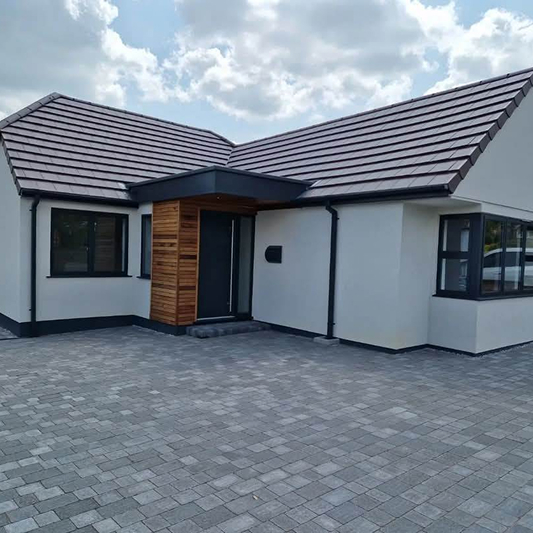
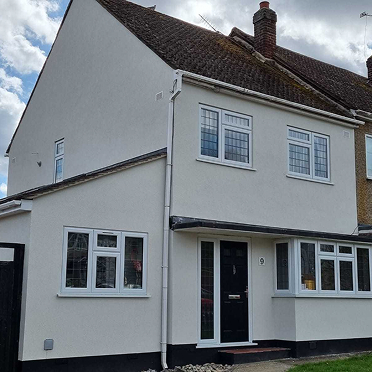
Harold Wood sits on the eastern side of Romford in the RM3 district, with the A12 running along its northern side and the A127 passing to the south. Most of the houses here went up between the wars, and a large number of them still wear the finish they were given at the time. That is where nearly every rendering enquiry from this part of Havering begins.
Much of the interwar stock across Havering was finished in pebble dash, and Harold Wood has a great deal of it. After the best part of a century on a wall, that finish usually looks worn long before it actually fails: uneven where it has been patched, dark where water runs off a cill, and beyond the reach of another coat of masonry paint. The question we get asked most often here is whether the dash has to be hacked off first. Usually it does not. We fix reinforcement mesh mechanically into the wall instead of bedding it into the base coat, which lets a new system be built up over the existing dash rather than after it. If you want the detail before committing to anything, we set it out on our page about rendering over an existing pebble dash finish.
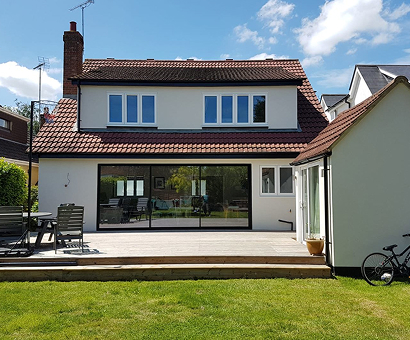
Harold Wood is bracketed by two busy roads, and road grime is a real consideration on any front elevation within sight of them. Traffic film settles on every wall, but it shows most on a painted surface, which then needs cleaning or recoating on a cycle the owner has to keep up with. A self-coloured silicone render behaves differently. Grime is shed rather than soaked up, the shade is the material itself instead of a coating over the top of it, and there is no repaint cycle to keep on top of. On a road carrying real traffic, that is the point of the material rather than a nice extra.
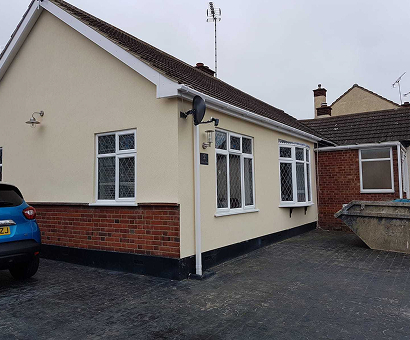
Harold Wood did not stop growing in 1939. Later twentieth-century housing and recent development sit around the interwar core, and those walls are a different proposition: a different substrate, often a different construction, sometimes already carrying render or cladding. Our approach is the same either way, which is to start with the wall rather than the postcode. On some of these houses the better discussion is external wall insulation with a render finish over it rather than render alone, so the wall gains something thermally while it is scaffolded.
A semi is half of a joined pair, and that shapes the job more than people expect. The elevation stops at a party boundary, so the finish has to be detailed to a clean, deliberate edge rather than dying out somewhere in the middle of a wall. Bay fronts of the period bring their own work, since the front of the house changes direction several times inside a couple of metres and each of those angles needs beading and reinforcing properly if the result is going to stay crisp. Houses of this age also vary in construction, some with a cavity and some without, so the wall is looked at on site before any system is specified, never assumed from the year the road was built.
We work right across this side of Havering, so alongside Harold Wood itself that means Harold Hill next door, Gidea Park in RM2, Romford, and out towards Brentwood on the far side of the A12. Upminster lies south of here, and although its housing has plenty in common with Harold Wood it is not the same stock at all. If your house is closer to that end of the borough, look at how we handle the large interwar frontages in Upminster.
Thirty years of rendering sits behind the work. Nothing goes on a wall unless it comes from a manufacturer approved system, and ours are SPS, Enviraul, Balmet and Atlas. Pinned mesh goes on every house we render, not only the awkward ones. Quotes are fixed and itemised before we start, and they do not move once agreed. Scaffolding is arranged as part of the job rather than left with you to sort out. We are fully insured. To talk a Harold Wood house through, call 07534 738068.
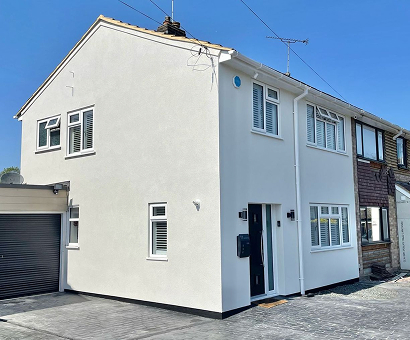
We regularly carry out rendering work across Harold Wood, Harold Hill and Kings Park — on inter-war semis, post-war family homes and newer builds. Whether your home currently has bare brick, pebble dash or ageing render, we will assess it honestly, advise on the best approach, and deliver a result that transforms the property. We also regularly work in the following areas close to Harold Wood:
In most cases, no. The dash is checked first for anything loose or blown and any failed areas are cut out and made good, but sound pebble dash stays where it is. The pinned mesh is mechanically fixed through into the wall, which is what makes rendering over the old finish a proper solution rather than a shortcut. It also means no skip full of hacked-off dash sitting on the front for a week.
It is one of the commonest situations on Harold Wood roads, and it gets settled at the design stage rather than on the day. The finish is stopped at the boundary with a proper edge detail so the line between the two houses reads as intentional. Some owners take the chance to speak to their neighbour and do both halves together, which gives the pair a single elevation again and usually means one scaffold instead of two.
Any wall facing a main road picks up traffic film. What matters is what happens next. A painted surface holds that dirt and eventually wants recoating, whereas a self-coloured silicone finish resists it and rain carries a good deal of it off. For houses on the busier Harold Wood roads, that tends to be the deciding argument for silicone over a cheaper finish that will need painting again.
No, and it should not be. The construction differs, the existing finish usually differs, and so does what the wall needs. We look at the substrate before recommending a system, and on the later housing the option worth weighing is whether to insulate the wall at the same time as rendering it, since the scaffold is going up either way.
If you’re planning a rendering project in Essex and want a contractor you can trust to do it properly — get in touch today. We’ll be happy to discuss your requirements, visit your property, and provide a clear, honest, no-obligation quote.