

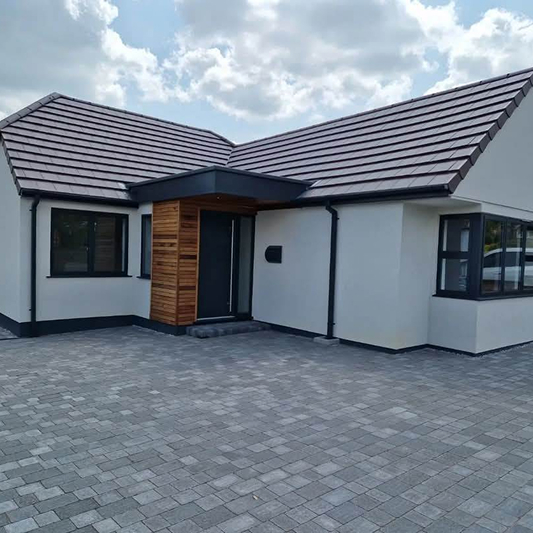
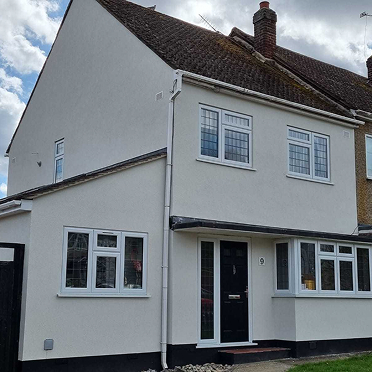
Rayleigh stands on high ground. The land climbs towards the town centre and falls away to the marshland south of it, with the Thames estuary only a few miles beyond that. For the people living there it is a view. For the walls it means weather arriving off open low ground with very little in the way to slow it down.
Wind-driven rain behaves nothing like rain falling on a sheltered wall. It is pushed flat into the face of the finish, worked into any hairline crack and held there, then driven in again before the wall has had a chance to dry out. Elevations in SS6 that look south and south-west across the low ground usually take the brunt of it, because there is almost nothing between them and the open land below the town.
Over a few years a wall taking that treatment starts to tell you about it:
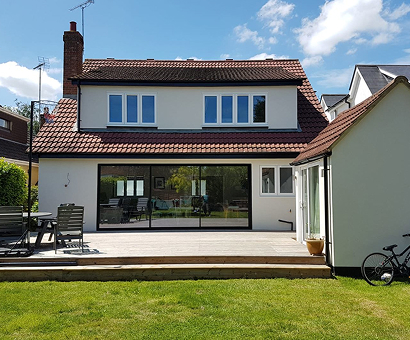
Two properties of a finish decide how well it copes up here. The first is breathability: moisture that has found its way into the masonry has to be able to leave again, and a sealed, painted skin traps it against the wall instead. The second is self-colour — with the colour through the render itself rather than sitting on top of it, there is no paint film for the weather to lift off the elevation that is taking the worst of it.
Silicon render answers both. It is breathable, so a wall that has taken water can still dry out through it. It is self-coloured, so there is no coating to fail separately from the render. It holds that colour without being repainted, it sheds dirt and driving rain, and it stays flexible enough not to crack as the masonry behind it moves. On an exposed elevation that is the finish we put forward. If you want to know what is actually in the system before you commit, here is what a silicon render build-up is made of.
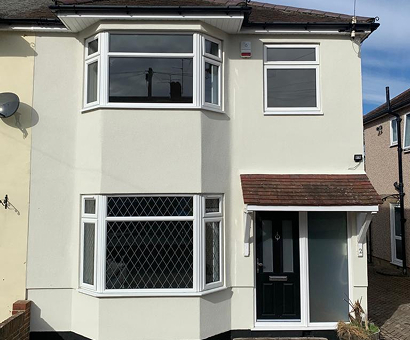
Much of the housing here is interwar and post-war semi-detached and bungalow stock, sitting on ground that steps up towards the centre. Two things follow from that. One is that a gable or a flank wall near the top of the hill is far more exposed than the same wall on a plot lower down — houses a few streets apart can want different specifications. The other is that construction from those decades varies: some walls are solid, some are early cavity, and which one you have changes how a system should be detailed at the edges.
It is also why we look at a house before quoting rather than pricing it over the phone. The wall needing most attention is rarely the one the owner had in mind.
Thirty years of rendering sits behind the work. Silk Render Ltd is fully insured on every job, and the systems going on your wall are manufacturer approved rather than whatever budget material the merchant is shifting that week. You get an itemised quote with a fixed figure on the bottom of it, so the price does not move while the work is going on. Access and scaffold are our responsibility to sort out rather than yours, and the site is left tidy at the end of each day. If you want a wall looked at, the number is 07534 738068.
Our work in this corner of Essex runs well past the SS6 boundary. Hockley and Hullbridge sit north and east in SS5, Rochford is over towards SS4, and Benfleet is south in SS7 on the far side of the A127. West of the A1245 the ground opens out towards Wickford — a town built on a completely different footing, which is why we keep a separate page for its bungalow streets. The A129 through Rayleigh and the station on the Southend line keep the whole of SS6 easy enough to reach.
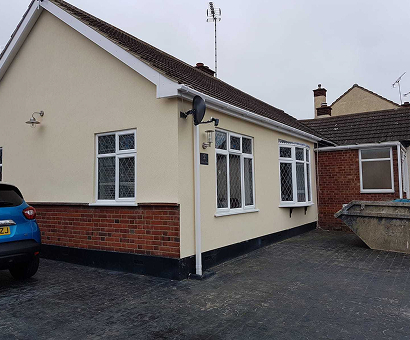
We regularly carry out rendering work across Rayleigh, Hockley and Hullbridge — transforming post-war semis, bungalows and family homes. Whether your home currently has bare brick, pebble dash or ageing render, we will assess it honestly, advise on the best approach, and deliver a result that transforms the property. We also regularly work in the following areas close to Rayleigh:
Usually the one facing the open ground to the south or south-west, since that is the direction the rain is driven from with least shelter in the way. It is not a rule, though. A plot lower down the slope, or one with mature trees or a neighbouring roof line in front of it, can have a completely different worst wall. We work it out from the house rather than from the compass alone.
Not on its own, and anyone promising that is overselling it. A breathable self-coloured system sheds driving rain far better than tired paint and lets the wall dry out between downpours, which is often the whole problem. But damp with another cause — a failed gutter, a bridged cavity, ground levels too high against the wall — has to be sorted first, or it will still be there under a new finish.
A self-coloured silicon finish keeps its colour without being repainted, which is the point of using one. There is no coating on the face of the wall to chalk, lift or wash off, so the elevation that takes the weather does not end up a different shade from the rest of the house. That is a large part of why we put it on exposed walls — repainting a south-west wall above the marshland every few years is not a small job once the scaffolding is factored in.
Sloping and stepped plots are ordinary around here given how the ground rises to the town centre. The scaffold gets set out to suit the ground rather than the other way round. That is ours to solve, and what it costs is in the quote you are given.
If you’re planning a rendering project in Essex and want a contractor you can trust to do it properly — get in touch today. We’ll be happy to discuss your requirements, visit your property, and provide a clear, honest, no-obligation quote.