

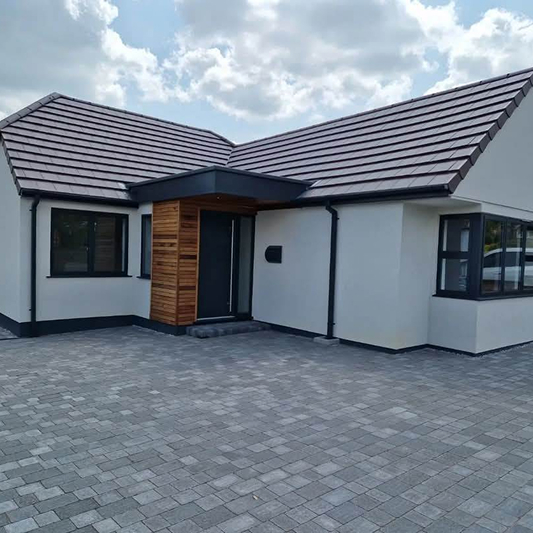
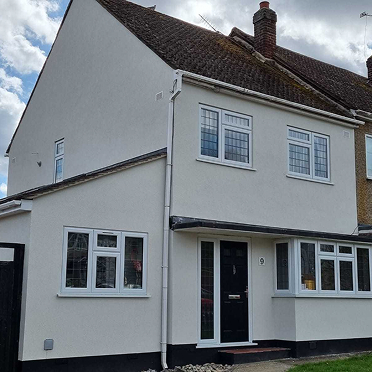
Wickford grew in an unusual way, and the walls still show it. Much of the town started life as interwar plotland — small parcels sold off one at a time for bungalows and smallholdings, put up by whoever happened to buy the plot. Large post-war and late twentieth-century estates were then laid out around that older core, so one SS11 or SS12 road can carry three or four different kinds of wall along its length.
Plotland houses were never built to a single specification. They went up in ones and twos, in whatever material was cheap and available at the time, and most have been extended, re-roofed or partly rebuilt since. A lot of Wickford homes therefore have an original elevation and later additions that are not the same construction at all.
That is worth establishing before you take a rendering quote here. A finish has to run across more than one substrate and still sit flat, with nothing opening up where old work meets new. It is a question of preparation rather than of which colour you fancy, and it is fair to ask any contractor how they intend to handle it.
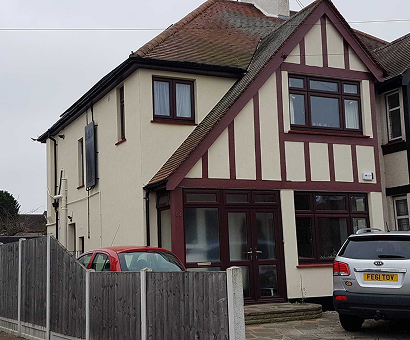
The estates built out from the town from the 1950s onwards are a different proposition again. Blockwork of that period has usually been painted, dashed or rendered at some point in its life, and what is on it now is often thin, patchy, or holding water where it has come away from the wall behind.
The answer on walls like that is pinned mesh. The reinforcement is screwed back into the masonry itself instead of being left floating in the base coat, so the new render has something solid holding it and copes with the wall moving underneath it rather than tearing. It is also what lets us go straight over existing pebble dash on most houses — no removal, no skips, no week of noise before the job proper starts.
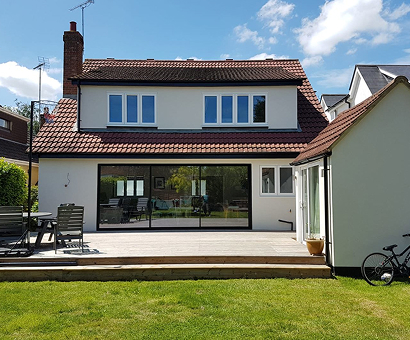
Painted render on a low bungalow wall becomes a job you inherit every few years. The alternative we recommend is silicon render. Its colour sits in the material rather than on top of it, so there is no paint film to blister off; it stays flexible enough to live with the small movements a long low wall makes, it lets the wall breathe, and dirt and rain come off it instead of soaking in. If you want the detail before you decide, read how silicon render behaves on a wall and hold it up against whatever is on your house now.
A bungalow is a different job from a two-storey semi. There is less height to reach, but every square metre of wall that does exist sits within easy sight from the pavement, so anything short of flat is obvious to anyone walking past. Wickford’s bungalow stock tends to bring the same handful of details with it:
None of that is difficult work, but it changes how a wall is set out and where the beads land.
We work across Wickford and the villages around it, Runwell included. Basildon lies south beyond the A127, Billericay to the west in CM11 and CM12, South Woodham Ferrers north-east, and Rayleigh east towards SS6 — if you are gathering quotes across that stretch, our page for Rayleigh homeowners deals with the exposed elevations you start to get closer to the estuary. The A132 runs through the town and Wickford station sits on the Southend Victoria line, so most roads in SS11 and SS12 are straightforward to get scaffolding into.
Silk Render Ltd has thirty years of rendering behind it. Every job is fully insured. Quotes are itemised and the figure at the bottom is fixed, so nothing new appears once the scaffold is up. The systems we install are manufacturer approved — SPS, Enviraul, Balmet and Atlas — because the material decides how long a finish survives on the wall, and we do not buy down on it. We put the scaffolding in place ourselves rather than leaving it for you to book. To talk through a Wickford property, call 07534 738068.
We regularly carry out rendering work across Wickford and Rayleigh — transforming post-war semis, bungalows and family homes. Whether your home currently has bare brick, pebble dash or ageing render, we will assess it honestly, advise on the best approach, and deliver a result that transforms the property. We also regularly work in the following areas close to Wickford:
In most cases, yes. The extensions are usually a different build from the original, so preparation changes from one section to the next and the reinforcement has to carry across the joins between them. Once the mesh is pinned and the base coat is on, the finish reads as one wall from the road. We would want to look at it first, which is what the quote visit is for.
Yes. A single-storey elevation is lower than a two-storey one, but the whole wall still has to be reached safely and worked from a stable platform if the finish is going to come out flat. The scaffold is ours to organise and it sits in the quote, so it is not a separate bill you go looking for later.
Yes — Wickford itself and the surrounding villages, including Runwell. Neighbouring towns such as Billericay, Basildon, South Woodham Ferrers and Rayleigh are on our list as well, so a house on the boundary makes no difference to us.
That is a common wall here and it takes render well. Blockwork of that age is usually sound but tired-looking, and the pinned mesh system will normally go over what is already up there rather than stripping it back. Where a section has blown or is holding water, that gets dealt with before anything else — we would rather cut a problem out than render over the top of it.
If you’re planning a rendering project in Essex and want a contractor you can trust to do it properly — get in touch today. We’ll be happy to discuss your requirements, visit your property, and provide a clear, honest, no-obligation quote.